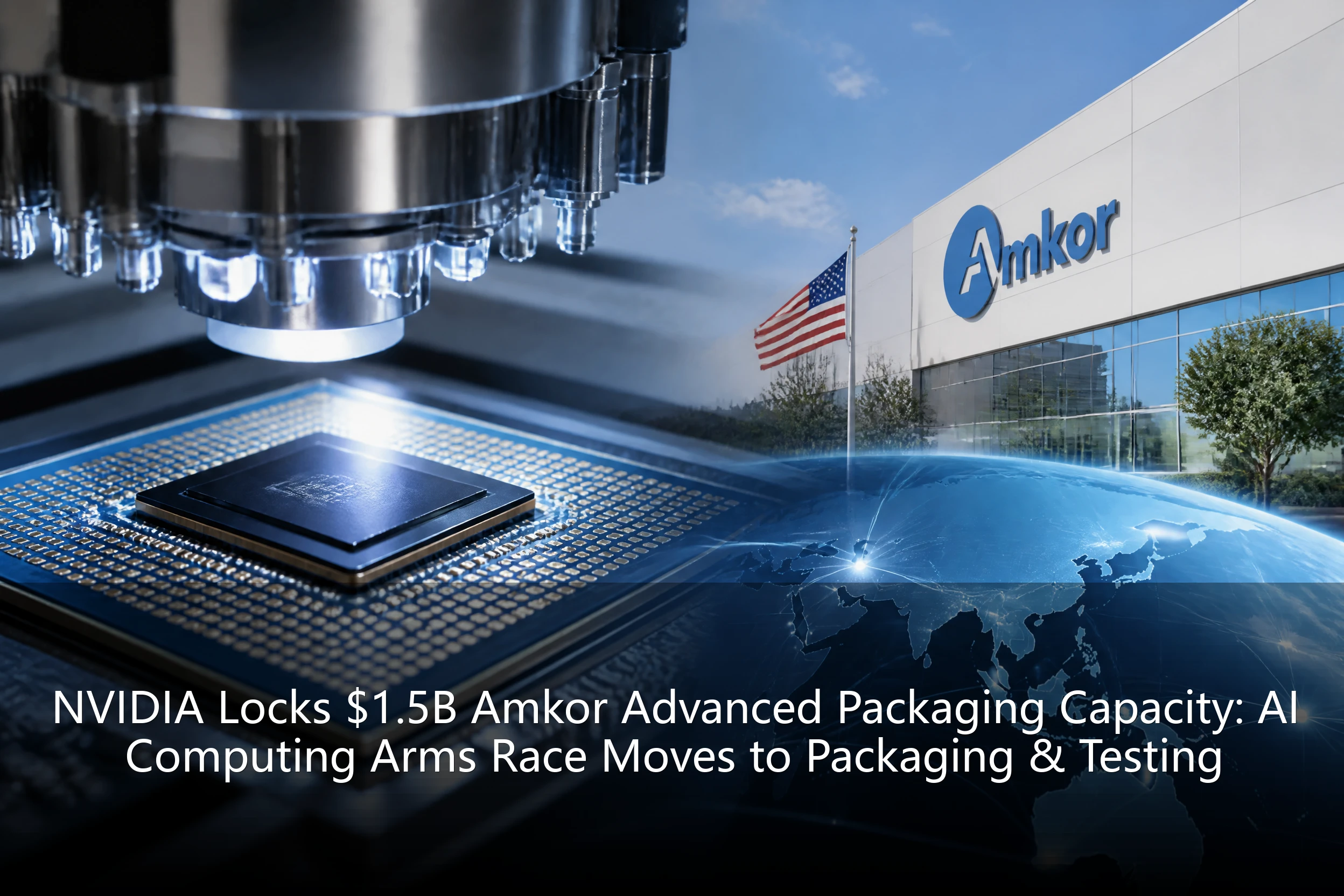
Global AI chip leader NVIDIA and Amkor Technology, an OSAT major headquartered in Arizona, announced on July 23 that the two companies have reached a multi-year strategic cooperation agreement worth approximately $1.5 billion (about RMB 10.17 billion). Under the agreement, NVIDIA will provide Amkor with an upfront payment to support its expansion of advanced packaging and test capacity in the United States for AI and accelerated computing platforms, focusing on the advanced packaging campus in Peoria, Arizona. Following the announcement, Amkor shares surged about 15% in after-hours trading to $73.3, and continued to climb about 9% in premarket trading the next day, making it one of the most closely watched events in the U.S. semiconductor sector recently.

1. $1.5B 'Capacity Lock-in': AI Giants Pay in Advance for Packaging Capacity

According to the joint announcement, the cooperation centers on joint R&D of advanced semiconductor packaging and testing technologies for next-generation AI and accelerated computing platforms, focusing on frontier directions such as high-density interconnect and next-generation heterogeneous integration, while deeply aligning long-term technology roadmaps. Debora Shoquist, NVIDIA's executive vice president of operations, said in a statement that Amkor's global capabilities and its investments in the United States are key components in building resilient AI infrastructure.

In fact, this is not the first cooperation between the two companies. Amkor has long provided advanced packaging solutions for NVIDIA's core product portfolio, including data center processors, networking chipsets and accelerated computing systems, and the partnership has been proven across multiple product generations. The value of the new agreement lies in NVIDIA, for the first time, using a more binding commercial arrangement — an upfront payment — to bring Amkor's U.S.-based capacity into the deterministic map of its supply chain.

The industry generally believes that NVIDIA's prepayment is essentially a 'capacity lock-in' strategy — by fronting funds, it ensures Amkor's Arizona production line can be delivered on schedule, providing stable packaging supply for next-generation AI chips around 2028. Analysts point out that chip design companies are only willing to bear the upfront capital cost to lock scarce packaging supply when they anticipate sufficiently large demand and highly stable monthly shipment demand. This move directly confirms the high prosperity of global AI computing demand and marks that competition among AI giants has officially expanded from the wafer foundry segment to the long-neglected packaging and testing segment.

2. From TSMC to Amkor: 'Prepaid Capacity' Model Extends to Third-Party OSAT

Notably, the rigid supply mechanism of 'prepayment + long-term supply agreement' has mostly appeared within cooperation frameworks between leading technology companies and TSMC. International giants such as NVIDIA, Apple and AMD have secured future quotas for advanced packaging capacity such as TSMC's CoWoS by paying funds in advance. This time, NVIDIA proactively extended the prepayment model to third-party OSAT Amkor, setting a benchmark in the industry.

Shanghai Securities News quoted industry insiders as saying that this event directly confirms that TSMC's advanced packaging capacity will remain in a tight supply-demand balance in the medium and long term. Affected by the explosive demand for AI chips and tight supply of upstream raw materials such as packaging substrates, advanced packaging capacity represented by TSMC's CoWoS remains in short supply, with prices trending upward. In this context, chip design giants have begun to seek a 'second source' to diversify supply chain risk, and Amkor, as the world's second-largest professional outsourced semiconductor assembly and test (OSAT) provider, naturally became the first choice.

In fact, the synergy between Amkor and TSMC had already been foreshadowed. In June 2026, the two companies signed a ten-year long-term strategic cooperation agreement, under which TSMC will continuously purchase one-stop advanced packaging and chip testing services from Amkor to support various advanced process chips produced at its Phoenix, Arizona wafer fab. People familiar with TSMC speculate that NVIDIA's prepayment to lock in Amkor capacity came right after the two companies' ten-year agreement, and TSMC may subsequently outsource some high-end packaging business to Amkor, forming a complementary pattern of 'TSMC wafer manufacturing + Amkor packaging and testing'.

Global advanced packaging capacity landscape: still highly concentrated

Currently, in mainstream AI chip packaging, TSMC holds the vast majority of market share with its CoWoS process, while ASE and Amkor each hold a small share. NVIDIA's incremental commitment is expected to help Amkor build a more stable order base in high-end AI packaging and push the global advanced packaging capacity landscape from 'single dominance' to 'multiple points of growth'.

3. Shoring Up U.S. Advanced Packaging: $7 Billion Campus Aligned with CHIPS Act

NVIDIA's funds will go directly into Amkor's advanced packaging campus in Peoria, Arizona. Launched in November 2023 with an initial investment of $2 billion, Amkor subsequently added more than $5 billion, bringing total project investment to about $7 billion. Upon completion, it will become the first high-volume advanced packaging fab in the United States. According to the plan, the phase-one facilities will be completed in mid-2027 and officially enter production in early 2028, with cleanroom space exceeding 750,000 square feet and creating up to 3,000 high-quality jobs. It will deploy mainstream high-end packaging processes such as InFO (Integrated Fan-Out) and CoWoS (Chip-on-Wafer-on-Substrate) to precisely meet the packaging needs of AI computing chips. Apple and NVIDIA have been explicitly named as key customers of the campus.

Notably, Amkor's expansion has also received up to $400 million in grants approved by the U.S. Department of Commerce under the CHIPS and Science Act (CHIPS Act), in addition to advanced manufacturing investment tax credits and state/local government support. The preliminary terms memorandum of the CHIPS and Science Act explicitly states that one of its fundamental goals is 'to create an advanced packaging ecosystem in the U.S. to ensure that chip production is performed domestically from start to finish'.

On the wafer manufacturing side, the U.S. 'reshoring' process is also accelerating. As of May 2026, three logic wafer fabs have entered mass production: TSMC Arizona Fab 21 Phase 1 (4nm), Intel's Ohio fab (18A) and Samsung's Taylor, Texas fab (3nm GAA). In addition, 12 funded wafer fab projects are under construction. TSMC also announced an additional $100 billion investment at its second-quarter earnings call, raising total investment in the Arizona project to $265 billion, with capacity already reserved by customers through 2028.

However, advanced packaging remains the most prominent weakness in the U.S. semiconductor supply chain. Currently, nearly 100% of leading-edge chips produced at TSMC's Arizona fab still need to be shipped back to Taiwan, China for advanced packaging before delivery to customers. Jan Vardaman, chief packaging researcher at TechSearch International, said bluntly that if packaging could be completed directly next to the Arizona wafer fab, customers would no longer need to ship chips back and forth between the U.S. and Asia, greatly shortening delivery times and reducing logistics and geopolitical risks. The NVIDIA-Amkor agreement is a direct response to this weakness.

4. Shifting Global OSAT Landscape: Implications and Opportunities for Asia-Pacific Supply Chains

This cooperation once again puts the competitive landscape of the global OSAT industry in the spotlight. Global advanced packaging capacity is currently highly concentrated in Asia, and Southeast Asia is becoming an important variable in this round of supply chain restructuring. Malaysia has announced the formation of the 'Malaysia Advanced Packaging Consortium' (MAPC), planning to invest more than 185 million ringgit to develop its domestic advanced packaging capabilities; Thailand has launched the 'National Semiconductor Roadmap 2050', introducing what are regarded as the most aggressive incentives in Southeast Asia; Vietnam and Singapore are also increasing policy and capital support. Meanwhile, OSAT giants such as ASE and Amkor are building second capacity bases in Southeast Asia, and the regional OSAT industry is leaping from traditional low-end packaging to high-end segments such as advanced packaging and automotive-grade chip testing.

For the packaging and testing industry in China and the Asia-Pacific region, NVIDIA's 'prepayment to lock capacity' model brings three lessons: first, the AI-driven industry growth logic has been validated by global leaders; second, the application scenario advantages of the AI inference era provide broader growth space for the Asia-Pacific local supply chain; third, forward-looking OSAT players should arrange capital investment and production line construction in advance to precisely capture the dividends from the AI industry's explosive growth.

However, the barriers to entry in the advanced packaging track are also rising. In terms of construction costs, the investment for a traditional OSAT plant is about $500 million, while an AI chip packaging and testing plant starts at $1 billion, with a construction cycle of at least two years and an additional 6 to 12 months to reach volume production. Global lead times for semiconductor packaging equipment have stretched to 6 to 8 months, and the high-end materials supply chain is also under strain. This means that those able to capture the AI packaging dividend will still mainly be leading players with capital strength and technology reserves.

Conclusion: OSAT Moves from 'Behind the Scenes' to 'Center Stage'

The $1.5 billion agreement between NVIDIA and Amkor is a landmark event in AI supply chain competition extending from wafer manufacturing to packaging and testing. On one hand, it confirms the scarcity of advanced packaging capacity — against the backdrop of explosive growth in AI computing demand, there are only a handful of manufacturers that can stably mass-produce high-end packaging processes such as CoWoS. On the other hand, it signals that the 'prepaid capacity' business model is spilling over from the TSMC ecosystem to the broader OSAT supply chain, reshaping industry valuation logic.

With NVIDIA's earnings report approaching in late August 2026, TSMC's Arizona capacity ramp progressing, and the U.S. advanced packaging ecosystem gradually taking shape, the linkage between the U.S.-listed OSAT sector and the Asia-Pacific semiconductor supply chain will continue to attract market attention. For cross-border practitioners and industry observers, the packaging and testing segment is moving from 'behind the scenes' to 'center stage', becoming a key window into the changing global semiconductor industry landscape.

en-ad-detail-full