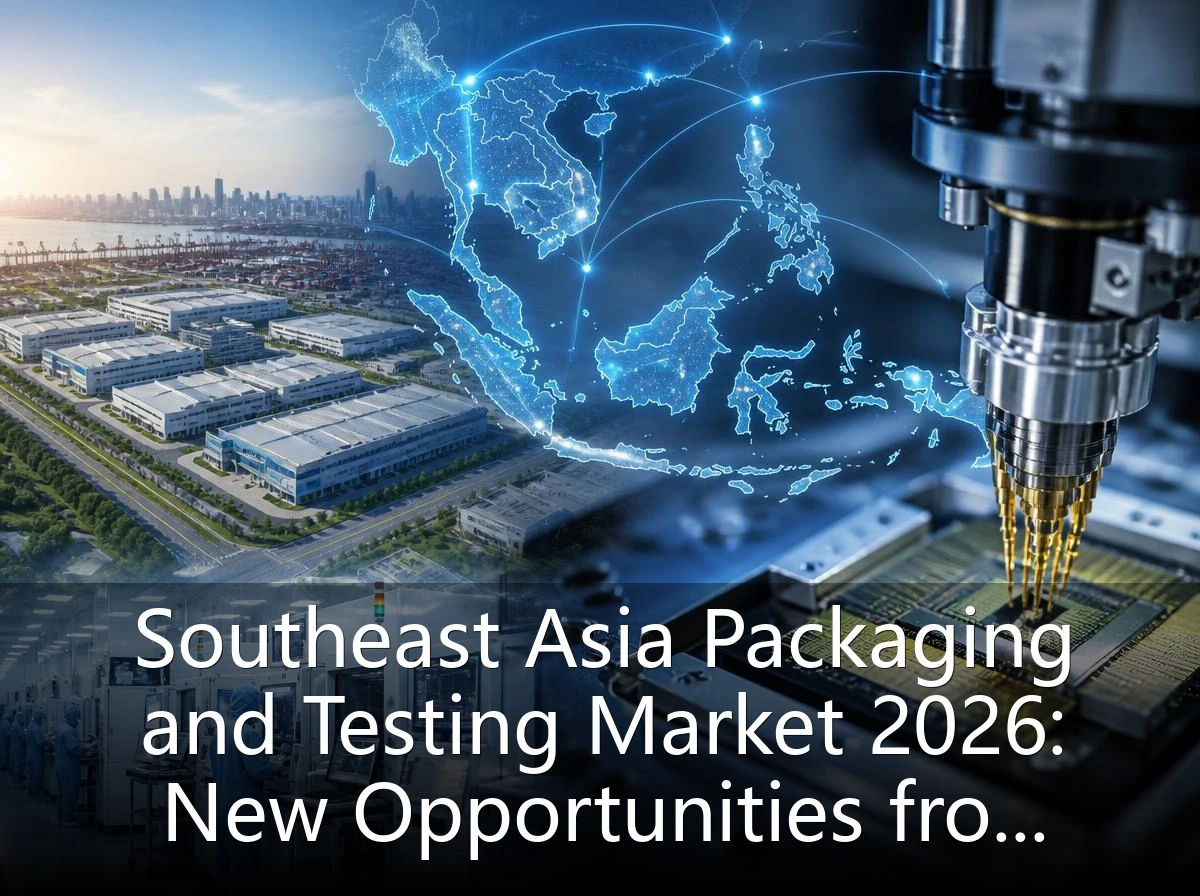
Southeast Asia Packaging and Testing Market 2026: New Opportunities from Regional Policy Dividends and AI-Driven Industrial Upgrading

With the restructuring of the global semiconductor industry landscape and the rapid development of AI technology, Southeast Asia is gradually becoming an important growth pole for the global packaging and testing industry, leveraging its geographical advantages, policy support, and labor cost advantages. As a critical link in the global semiconductor industry chain, packaging and testing technology not only affects the performance and reliability of chips but is directly related to the competitiveness of the entire semiconductor industry. This article will provide an in-depth analysis of the development status, policy environment, new opportunities driven by AI, and regional layout of US-listed packaging and testing companies in the Southeast Asia packaging and testing market, offering comprehensive market insights and investment references for investors.

Current Status and Characteristics of the Southeast Asia Packaging and Testing Market

Thanks to its geographical location, labor cost advantages, and strong government support, Southeast Asia has become an important production base for the global packaging and testing industry. Countries such as Vietnam, Malaysia, Thailand, and Singapore each have their own characteristics in the packaging and testing field, forming a complementary industrial layout.

Vietnam, with its relatively young and cost-effective labor resources, and the semiconductor industry policies actively promoted in recent years, has attracted investment from many international packaging and testing giants. Vietnam's "Semiconductor Development Plan 2025" explicitly aims to become an important part of the global semiconductor industry chain, especially in the advanced packaging sector, with plans to attract over $10 billion in investment.

Malaysia, with its mature semiconductor industry foundation and English proficiency advantages, has become an important choice for packaging and testing companies. Malaysia's "Semiconductor Strategy 2.0" plans to invest $5 billion over the next five years, focusing on developing advanced packaging technology, with the goal of making Malaysia one of the global packaging and testing centers.

Thailand focuses on the packaging and testing field for automotive electronics and industrial control chips, forming a distinctive packaging and testing industrial cluster leveraging its automotive manufacturing advantages. Thailand's "5 Billion Baht Advanced Packaging Special Fund" provides financial support for packaging and testing companies to promote industrial upgrading.

Singapore, as the technology center of Southeast Asia, occupies a leading position in high-end packaging and R&D. Singapore's "3 Billion Singapore Dollar Advanced Packaging Flagship Program" has attracted many international giants to establish R&D centers, promoting technological innovation.

Analysis of Regional Policy Dividends

Southeast Asian governments have successively introduced preferential policies to attract packaging and testing industry investment, forming a multi-level policy support system. These policies not only include traditional incentives such as tax breaks and land supply but also cover support in talent cultivation, technology R&D, and industry chain construction.

Vietnam's "Semiconductor Development Plan 2025" provides a series of preferential policies, including corporate income tax reductions, land use benefits, and R&D subsidies. Notably, Vietnam's agreement with the EU on the Carbon Border Mechanism provides policy guarantees for the green development of the semiconductor industry, attracting environmentally conscious packaging and testing companies to invest.

Malaysia's "Semiconductor Strategy 2.0" focuses more on technological innovation and talent cultivation, with the government planning to invest $1 billion in semiconductor talent training and establishing research centers in cooperation with many internationally renowned universities. In addition, Malaysia has launched the "Packaging and Testing Industry Cluster Program," establishing dedicated packaging and testing industrial parks in Penang, Kuala Lumpur, and other places to provide one-stop services.

Thailand's "Advanced Packaging Special Fund" focuses on supporting enterprise technology upgrading and capacity expansion, with the fund prioritizing support for advanced packaging technology R&D and application in fields such as automotive electronics and industrial control. The Thai government has also established semiconductor industry cooperation mechanisms with countries such as Japan and South Korea to introduce advanced technologies and management experience.

Singapore's advanced packaging flagship program places greater emphasis on R&D and innovation, with the government planning to invest $1.5 billion in advanced packaging technology R&D and establishing multiple industry-academia-research cooperation platforms. Singapore has also launched a "Talent Attraction Program" offering competitive salaries and benefits to international semiconductor talent.

Development Opportunities Driven by AI

With the rapid development of AI technology, the demand for high-performance chips has surged, bringing unprecedented development opportunities for the packaging and testing industry. AI chips place higher requirements on packaging technology, including higher integration, lower power consumption, and better heat dissipation performance, providing opportunities for technological and industrial upgrading of Southeast Asia's packaging and testing industry.

First, the demand for advanced packaging technology from AI chips has driven the technological upgrading of Southeast Asia's packaging and testing industry. Traditional packaging technology can no longer meet the high-performance requirements of AI chips, with advanced packaging technologies such as 2.5D packaging, 3D packaging, and fan-out packaging becoming mainstream. Southeast Asian governments and enterprises have increased investment in advanced packaging technology R&D to promote technological upgrading.

Second, the explosive growth of AI chips has driven the expansion of packaging and testing capacity. As AI application scenarios continue to expand, from data centers to autonomous driving, from healthcare to smart manufacturing, the demand for AI chips is showing explosive growth. This has provided broad market space for Southeast Asia's packaging and testing industry, attracting many international packaging and testing giants to expand capacity in Southeast Asia.

Third, the global layout of the AI industry chain has brought collaborative development opportunities for Southeast Asia's packaging and testing industry. With the global layout of the AI industry chain, the packaging and testing link is gradually shifting to Southeast Asia, which has obvious cost advantages. At the same time, the design, manufacturing, packaging, and testing of AI chips have formed a closely integrated industry chain, providing supporting development opportunities for Southeast Asia's packaging and testing industry.

Layout of US-listed Packaging and Testing Companies in Southeast Asia

As the importance of the Southeast Asia packaging and testing market continues to grow, many US-listed packaging and testing companies have accelerated their layout in Southeast Asia, forming a diversified investment landscape.

As a global leader in packaging and testing, Amkor's investment in Southeast Asia has been particularly noteworthy in recent years. In early 2026, Amkor announced a $2 billion investment in Vietnam to build an advanced packaging factory, expected to be operational in 2027, mainly producing advanced packaging products for AI chips and automotive electronics chips. In addition, Amkor has expanded its existing factory in Penang, Malaysia, increasing advanced packaging capacity to meet the demand for AI chips.

As another packaging and testing giant, ASE Group is also actively expanding in Southeast Asia. In 2026, ASE announced a $2 billion investment in Malaysia to build an advanced packaging R&D center and production base, focusing on the packaging and testing of AI chips and 5G chips. ASE has also cooperated with the Malaysian government to establish a semiconductor industrial park in Penang, attracting supporting enterprises to settle in.

As a US-listed packaging and testing company, JCET has also increased its investment in Southeast Asia in recent years. In 2026, JCET invested $1.5 billion in Thailand to build an advanced packaging factory, mainly serving the automotive electronics and industrial control chip markets. JCET has also cooperated with the Thai government to establish a semiconductor talent training base locally to provide talent support for industrial development.

In addition, US-listed packaging and testing companies such as ASE Group, STATS ChipPAC, etc. are also actively expanding in Southeast Asia, forming a diversified investment landscape. The investment of these companies has not only driven the development of Southeast Asia's packaging and testing industry but also created a large number of local jobs, promoting technology transfer and industrial upgrading.

Future Development Trends and Investment Recommendations

Looking ahead, the Southeast Asia packaging and testing market will show several development trends:

  • First, technological innovation will become the core competitiveness. As AI chips continue to place higher requirements on packaging technology, advanced packaging technology will become the core competitiveness of packaging and testing companies. Southeast Asian countries will increase investment in technology R&D to promote technological innovation and enhance industrial competitiveness.
  • Second, the industrial cluster effect will become more apparent. With the aggregation of packaging and testing companies in Southeast Asia, the industrial cluster effect will become more apparent, forming a fully supporting industrial chain, reducing production costs, and improving production efficiency.
  • Third, green manufacturing will become the development direction. With the continuous improvement of global environmental requirements, green manufacturing will become an important development direction for the packaging and testing industry. Southeast Asian countries will strengthen environmental standards, promote green manufacturing, and improve the sustainable development capacity of the industry.

Based on the above analysis, the following recommendations are made to investors:

  • First, focus on packaging and testing companies with technological advantages. With the development of AI technology, advanced packaging technology will become the core competitiveness of packaging and testing companies, and investors should focus on companies with technological advantages in the advanced packaging field.
  • Second, focus on packaging and testing companies with deep layout in Southeast Asia. As the importance of the Southeast Asia packaging and testing market continues to grow, packaging and testing companies with deep layout in Southeast Asia will benefit from the development of the regional industry.
  • Third, focus on the packaging and testing industry in countries and regions with strong policy support. The degree of government support for the packaging and testing industry varies in Southeast Asian countries, and investors should focus on the packaging and testing industry in countries and regions with strong policy support.
  • Finally, focus on packaging and testing companies that develop synergistically with the AI industry chain. With the global layout of the AI industry chain, packaging and testing companies that develop synergistically with the AI industry chain will benefit from the development of the entire industry chain.

Conclusion

Under the dual effects of regional policy dividends and AI technology-driven development, the Southeast Asia packaging and testing market is facing unprecedented development opportunities. Countries such as Vietnam, Malaysia, Thailand, and Singapore, leveraging their respective advantages, have formed a complementary industrial layout, attracting investment from many international packaging and testing giants. In the future, with the acceleration of technological innovation and the emergence of industrial cluster effects, the Southeast Asia packaging and testing market will further consolidate its position as an important base for the global packaging and testing industry. For investors, focusing on packaging and testing companies with technological advantages, deep layout in Southeast Asia, benefiting from policy support, and developing synergistically with the AI industry chain is expected to obtain considerable investment returns.

Detail Page Advertisement