Musk Expands Business Empire: Acquisition of Mesh Targets Space Computing
Keywords: Musk; Mesh; space computing; SpaceX listing; optical communication technology; Starmind project
Introduction
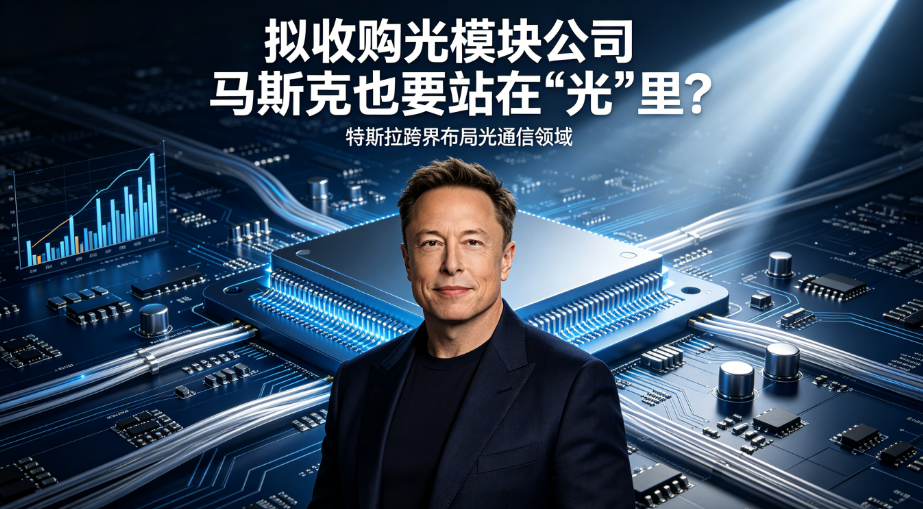
Amid the global wave of artificial intelligence, computing power has become a core resource for tech giants. Following the acquisition of AI startup Cursor, Elon Musk struck again by acquiring Mesh Optical Technologies Corp, a company specializing in optical communication technology for data centers, further expanding his business empire. This acquisition is not only about ground data center technology innovation but is also seen as a key step for SpaceX to advance its space computing strategy—building a bridge of light-speed connectivity between humans and machines may be at the core of Musk's next grand vision.
I. Mesh: From Silicon Valley to Space, a Pioneer in Optical Communications
According to information disclosed by the US Federal Trade Commission (FTC), Elon Musk has recently received approval to acquire Mesh Optical Technologies Corp, but specific deal details have not been made public. This startup, founded by three former SpaceX engineers, may keep a low profile but possesses significant technological accumulation in the field of optical communications.
A LinkedIn search reveals that Mesh's co-founders all previously participated in the research and development of laser communication technology for SpaceX's Starlink internet satellite system. This technical background gives Mesh a natural "interstellar connection" gene. The company's official website states that its first product, the Alpha C1, is an optical transceiver capable of linearly converting electrical signals into optical signals at a rate of 1.6 terabits per second (Tbps). This high-speed, low-latency, high-reliability optical communication technology precisely addresses the pain points of current AI workloads and power-constrained data centers.
Mesh's long-term vision is even more ambitious—building an optically interconnected solar system connecting humans, computers, spacecraft, and deep space probes. The company has secured over $50 million in funding led by Thrive Capital, reflecting capital market recognition of this technology path.
II. Strategic Considerations Behind the Acquisition: Filling a Key Piece of Space Computing
This acquisition is far from a simple technology investment; it is a crucial piece in Musk's chess game for SpaceX's "space computing" strategy. SpaceX previously stated in its IPO filing that the company plans to manufacture, launch, and operate up to one million AI computing satellites, with the core goal of building a distributed AI computing cluster in space.
Why deploy AI computing in space? This stems from a deep insight into the dilemmas faced by ground data centers: increasingly tight power supply, rising cooling costs, and scarcity of land resources. For example, training a single large AI model can consume tens of thousands of kilowatt-hours of electricity and requires extremely high cooling. In contrast, the space environment offers abundant solar energy and natural low temperatures—solar power generation is far more efficient than on the ground, and the vacuum of space enables efficient cooling.
Musk recently responded on social media to confirm that SpaceX's planned orbital AI data center project is named Starmind. The optical communication technology developed by Mesh will serve as the "nervous system" for connecting ground and space, as well as satellites to satellites, handling the massive transmission of data.
III. Commercialization: Computing Power Contracts and Partnership Ecosystem
In addition to the acquisition, SpaceX signed several computing power contracts around the time of its IPO to further advance its commercialization process. According to public information, SpaceX has successively reached multiple cooperation agreements with Anthropic, Google, and AI startup Reflection, opening up its chip and data center resources to external clients.
These collaborations highlight the business logic of SpaceX's space computing strategy: not only serving its own Starlink network and AI applications, but also aiming to open this infrastructure to third parties, forming a "computing power as a service" model similar to AWS. As the AI race intensifies, whoever can first provide low-cost, high-reliability computing power resources will hold the key to the next era.
IV. Controversies and Challenges: Masayoshi Son's Skepticism and Market Scrutiny
However, SpaceX's space computing strategy has not been universally endorsed. Masayoshi Son, Asia's richest man and founder and CEO of SoftBank Group, raised sharp questions at the annual general meeting, stating that the space data center concept proposed by Musk and others "doesn't make much sense," and that the outcome of the AI competition will be determined primarily by terrestrial computing power resources, not future orbital computing facilities.
Son analyzed from a cost structure perspective: although space can use solar energy to reduce electricity costs, electricity accounts for only a small part (about 7%) of data center operating costs, while core costs like chips and hardware account for as much as 93%. In contrast, the high costs of launching equipment into orbit, subsequent maintenance, and communication latency issues will far outweigh potential electricity savings.
This view has some merit. Space does pose many challenges: launch costs, though declining, remain high; in-orbit maintenance and fault repair are nearly impossible; and despite the speed of optical communication, latency between ground and satellites is still far higher than connections between data centers in the same city. For most AI application scenarios, microsecond-level latency may not be sensitive, but for real-time response applications, space computing's efficiency advantage would be significantly diminished.
V. Capital Market Reaction: SpaceX's Stock Price in Turmoil
The secondary market's reaction to SpaceX's recent moves has been complex. The company's stock price fell sharply from $201.80 per share on June 16 to $153.23 per share on June 26, experiencing a "roller coaster" ride. This volatility reflects both ongoing market doubts about the commercial viability of space computing and the broader cyclical adjustment of tech valuations.
In fact, investors' judgment of SpaceX is being influenced by multiple intertwining factors: on one hand, the scaling of the Starlink business brings stable cash flow expectations; on the other hand, the timeline and cost-benefit model of the space computing strategy remain highly uncertain. Acquiring technology companies like Mesh, while strengthening technological barriers in the long run, will increase capital expenditure and dilute profits in the short term.
VI. Future Outlook: An Interstellar Computing Network Powered by Optical Communication
From a longer-term perspective, Musk's acquisition of Mesh goes far beyond a single business transaction. It marks the germination of a paradigm shift from "ground computing" to "interstellar computing." If SpaceX successfully builds the Starmind project and achieves efficient interconnection using Mesh's optical communication technology, future human society will no longer be constrained by geographic space and ground computing bottlenecks.
Imagine a scenario: through space AI computing clusters, residents in remote areas can obtain AI services of the same quality as those in first-tier cities; researchers can use low-cost space computing for climate simulations, genetic analysis, or astronomical research; even deep space probes can directly leverage orbital AI resources for autonomous decision-making, without waiting for ground commands.
Of course, all this still requires time to verify. Son's skepticism reminds us that technological idealism must be combined with business reality. The implementation of space computing needs to solve multiple core issues: cost, latency, maintenance, and reliability. But looking back at Musk's business trajectory—from mass production of electric vehicles to commercial operation of reusable rockets—every "impossible" technology path has ultimately proved its feasibility.
The Mesh acquisition may be a significant anchor for SpaceX in the blue ocean of space computing. When the light of optical connections pierces the atmosphere and illuminates the new frontier of human intelligence, we will witness the gradual formation of a computing power network even more magnificent than ground data centers. And Musk, with his accustomed speed and ambition, is bringing this future closer.